Restaurant diners are happier than owners fear, and they forgive price faster than bad service. This local SEO analysis of 19,659 Google Business Profile reviews from 11 restaurants, built with Python, found only 6.1% were 1-2 star, food quality drove 44.4% of praise, and about 10% of the 1-2 star complaints mentioned price.
What I analysed and how
This analysis is for restaurant and F&B owners. I analysed 19,659 reviews from the Google Business Profile accounts of 11 restaurants. The pipeline was simple. I scraped the reviews with Python Selenium, processed the text with spaCy and BERT, then used the Gemini API to classify what people were actually talking about. I first shared the results on Facebook in January 2026, and this is the full version.
A Google Business Profile is the listing diners see in Google Maps and local search results, which is why its reviews are such a clean source of customer opinion. One honest limit: 11 restaurants is a focused sample, not the whole F&B industry. The patterns are consistent enough to act on, but benchmark your own reviews before you change anything big. Pulling and classifying your reviews is part of the local SEO work I do for F&B clients.
How many restaurant reviews are actually negative?
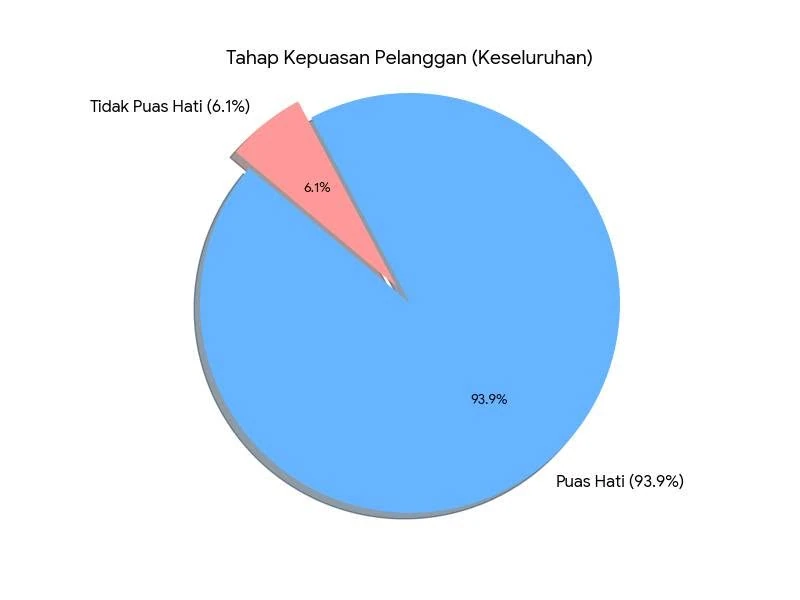
Very few. Out of nearly 20,000 reviews, the share of 1-2 star reviews was 6.1%, which leaves 93.9% of diners satisfied. That gives you a practical benchmark. If your Google Business Profile has a higher share of 1-2 star reviews than 6.1%, something in your operation needs fixing. If it is lower, a few bad reviews are normal and not a crisis.
What do diners praise in 4-5 star reviews?
| What diners praise | Share |
|---|---|
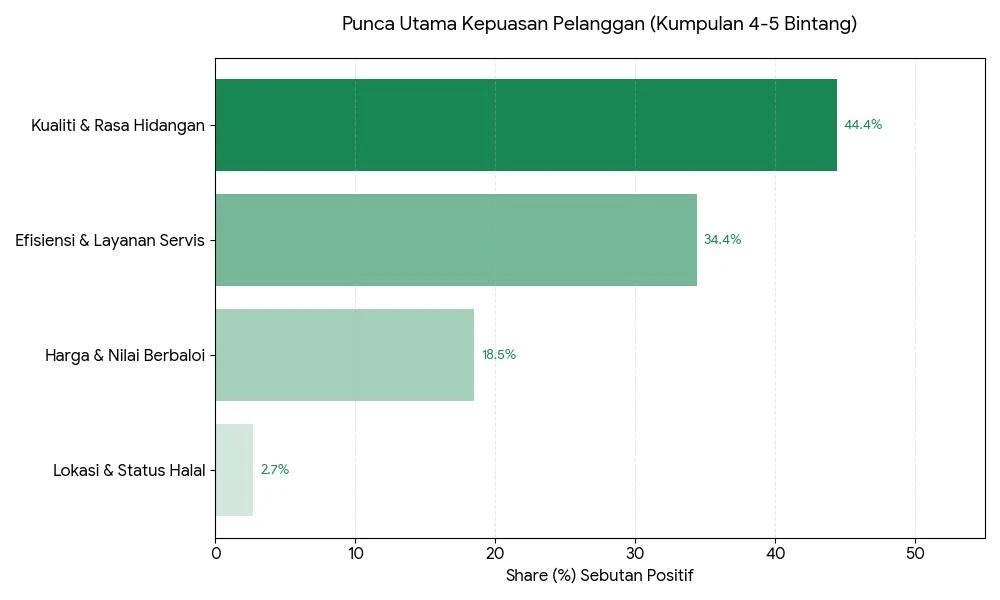
| Food quality and taste | 44.4% |
| Service and efficiency | 34.4% |
| Price and value for money | 18.5% |
| Location and halal status | 2.7% |
Good food plus fast, friendly service is the winning combination. Location and halal status are rarely the reason someone writes a happy review, which suggests they are baseline expectations rather than differentiators.
What are the 6.1% unhappy about?
| Complaint in 1-2 star reviews | Share |
|---|---|
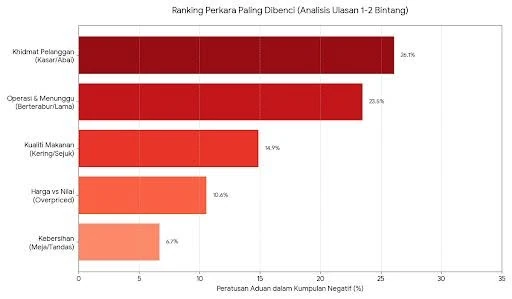
| Customer service | 26.1% |
| Operations and waiting time | 23.5% |
| Food quality | 14.9% |
| Overpriced feeling | 10.6% |
| Cleanliness | 6.7% |
Customer service and operations together are about half of all the complaints. Both happen at the front of the restaurant, at the door and the counter, which is where the diner forms a first impression. My suggestion is to fix the entrance experience first: who greets the guest, how fast they are seated and how clearly the wait is explained.
Is price the real problem?
No. Only about 10% of the 1-2 star reviewers complained about price, and those reviewers are only 6.1% of all reviews. In plain terms, diners do not mind the amount. They mind paying that amount for an experience that did not match it.
If your restaurant is struggling, discounting is usually the wrong first move. Check service speed and the welcome before you cut the menu price.
When do most complaints happen?
Lunch. The complaint rate for lunch visits was 11.6%, against 4.4% for dinner, so a lunch diner was about 2.6 times as likely to complain. The reviews describe slow service and a hot, crowded room. Lunch is the easiest window to trigger an unhappy diner because people are on a time limit.
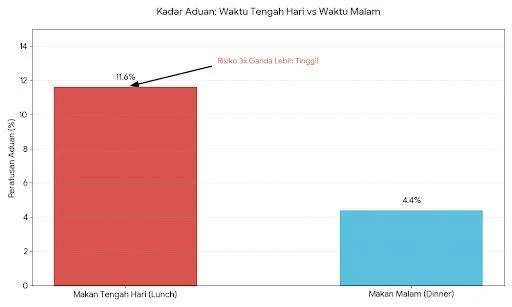
Staff the lunch shift for the rush, not the average, and tell guests the realistic wait when the room is full.
Why do some diners give 3 stars?
Three-star reviewers mostly write about expectations. A typical pattern is that the restaurant looked beautiful online, the food looked delicious and the staff were expected to be friendly, but the real visit was something else, so the diner settled on 3 stars.
When I broke the 3-star group down, the points they lost were service and staff speed (34.3%), a hot or crowded room (30.2%), price and value (24.5%) and average food (11.0%). Notice that price matters more here than in the 1-2 star group. A 3-star diner is the one who will tell you the visit was fine but not worth what they paid.
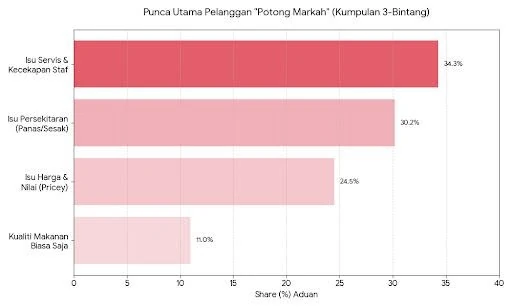
The fix is not better food. It is making your photos, your Google Business Profile description and your menu photos match what a diner actually gets. A gap between the promise and the table creates 3-star reviews.
Which marketing channels do diners mention?
The chart shows each channel's share of mentions in the reviews:
- Instagram: 18.08%
- Word of mouth (a friend invited them): 3.82%
- TikTok: 2.81%
- YouTube: 1.04%
- Viral posts (general): 0.36%
- Facebook, blogs and others: 0.05%
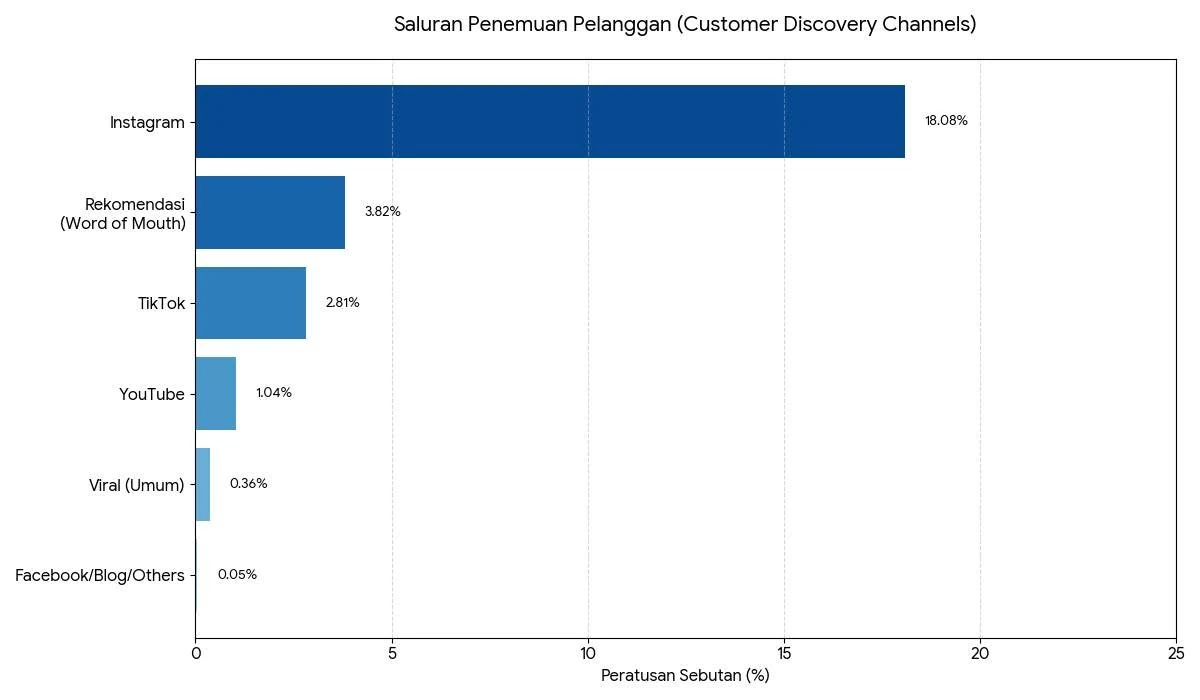
Reviews do not let me claim a precise result for any single channel, so I will not. The useful reading for social media marketing in F&B is that image and video-led platforms were mentioned most. Diners also pointed to the Google Business Profile rating as how they verified trust, the same validation step I found in the clinic review analysis.
What should a restaurant owner do with this?
- Benchmark your 1-2 star share against 6.1%.
- Fix the front-of-house welcome and the lunch rush before touching price.
- Make your photos honest, so the 3-star gap closes.
- Put your effort into Instagram, short video and a well-kept Google Business Profile, so that local search and social media marketing support each other.
For the fundamentals, read local SEO services in Malaysia and local marketing strategies for service-based companies. If you want to see how the scraping and analysis side works in Python, see the power of Python in marketing.
Want your own restaurant's reviews analysed this way? Message me on WhatsApp.
Frequently asked questions
What percentage of restaurant Google reviews are negative?
In 19,659 reviews across 11 restaurants, only 6.1% were 1-2 star reviews. If your own share of 1-2 star reviews is below 6.1%, you are doing better than this sample. If it is above, something in your operation needs attention.
What do diners praise most in a 4-5 star restaurant review?
Food quality and taste led at 44.4%, followed by service and efficiency at 34.4%, price and value at 18.5%, and location and halal status at 2.7%.
What do diners complain about in 1-2 star reviews?
Customer service issues were the biggest complaint at 26.1%, then operations and waiting at 23.5%, food quality at 14.9%, an overpriced feeling at 10.6%, and cleanliness at 6.7%.
Is price the main reason diners leave bad restaurant reviews?
No. Only about 10% of the 1-2 star reviews, which are themselves 6.1% of all reviews, complained about price. Diners rarely care about the amount when the food and service match what they expected.
Which marketing channels do restaurant diners mention in reviews?
Instagram was mentioned most at 18.08%, then word of mouth at 3.82%, TikTok at 2.81% and YouTube at 1.04%. Video and image-led social media worked best for the restaurants in this sample.
How was the restaurant review data analysed?
I scraped the reviews from the Google Business Profile accounts of 11 restaurants using Python Selenium, processed the text with spaCy and BERT, and used the Gemini API for the analysis. It is a sample of 11 restaurants, so read it as a pattern rather than an industry average.