Irish patients choose between the public system run by the Health Service Executive (HSE) and private care, and the choice usually turns on insurance and waiting time. This site was built for the private side of that decision: hospitals, GP clinics and specialist consultants across Dublin, Cork, Galway, Limerick and Waterford.
The Challenge
- Health is a regulated, high-trust topic, so Google filters out thin or anonymous sites.
- Patients rarely search for a clinic alone. They want to know whether VHI, Laya or Irish Life Health covers it, and whether they need an HSE referral first.
- Those same questions now appear inside AI answers, so each page has to work in both places.
The Strategy
1. Query trees built on Irish health logistics
Head terms were private hospitals Dublin, GP clinic Cork and specialist consultants Ireland. Each template answers the chain of questions around them:
- Cost and insurance: "Private health insurance consultation cost orthopedic surgeon Galway"
- Comparison: "VHI vs Laya Healthcare approved cardiology clinics Limerick"
- Process: "HSE referral pathways vs private medical appointments Ireland"
Insurer panel names, clinical terminology and local medical council standards run through the copy, so the pages match how people in Ireland phrase these searches.
2. A trust filter on the data
- Clinic listings, practitioner accreditations and service data were collected with Python scripts.
- Facilities rated below 4 stars, or without verified Irish Medical Council registration, were removed and 301-redirected to stronger category pages.
- Titles rotated across five sentence patterns naming real places, including Dublin 2, Cork City, Galway, Limerick and Waterford, so neighbouring pages do not compete with each other.
- Missing hours or contact links show a dash instead of a broken string.
3. One accountable author
A single author card on every content page ties the site to a named expert and a consistent entity record, which gives readers and algorithms an owner they can check.
The Result
Search Console, 8 to 28 October 2026:
| Metric | Value |
|---|---|
| Total clicks | 81 |
| Total impressions | 22,600 |
| Average CTR | 0.4% |
| Average position | 18.5 |
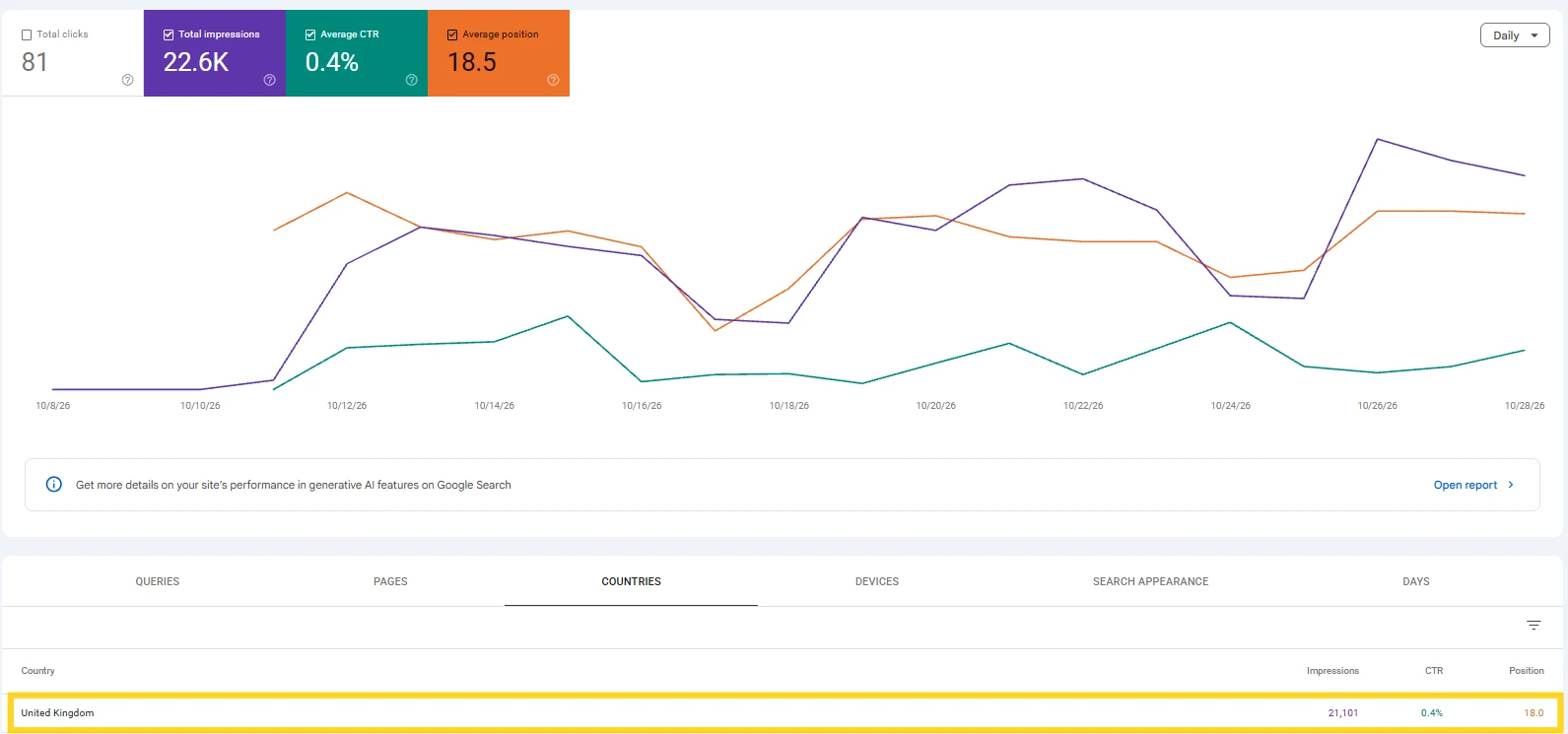
Impressions rise through the three weeks and the average position sits in the high teens, one page from the first results. The highlighted country row shows 21,101 of those impressions came from the United Kingdom at an average position of 18.0, so the site is being surfaced to patients on both sides of the Irish Sea.
Why this approach works
AI systems prefer structured, entity-backed sources. Linking the site to clean schema and a verified author lets models parse and cite the pages. Rotating the title formats captures long-tail patient searches across regions without cannibalisation, and filtering weak providers keeps engagement signals healthy.
How to apply this
- Map the site to recognised entities and link providers to the official medical bodies.
- Let one template answer the treatment question and the logistics question (insurance, waiting time, location).
- Automate data audits that remove low-rated entities, keep the dash fallback, and maintain clean 301 paths.
- Write short definitions and comparison tables that generative engines can lift directly.